Before Velveeta, America Had a Cheese Culture Nobody Told You About
Before Velveeta, America Had a Cheese Culture Nobody Told You About
Ask most Americans to name a cheese with deep roots in this country, and you'll get a short list. Cheddar, maybe. Colby. Something vague about Vermont. What almost nobody mentions — because almost nobody knows — is that colonial-era America had a surprisingly rich cheese culture, built on English and Dutch traditions, local herbs, and farmstead techniques that were genuinely distinct. Then industrialization arrived, and most of it quietly disappeared.
What got lost wasn't just a food. It was an entire chapter of American culinary identity.
The Cheeses That Came Before
In the 1700s, cheese was a household staple across the colonies — not a luxury, not a specialty product, but a practical way to preserve milk before refrigeration existed. Early American cheesemakers, many of them drawing on English farmhouse traditions, produced wheels that ranged from simple fresh curds to aged rounds flavored with garden herbs.
Sage Derby was one of the most common. Made with fresh sage worked directly into the curds, it had a mottled green appearance and an earthy, mildly herbal flavor that complemented the preserved meats and rough bread typical of colonial tables. It wasn't exotic — it was just what cheese looked like in a lot of American kitchens for a very long time.
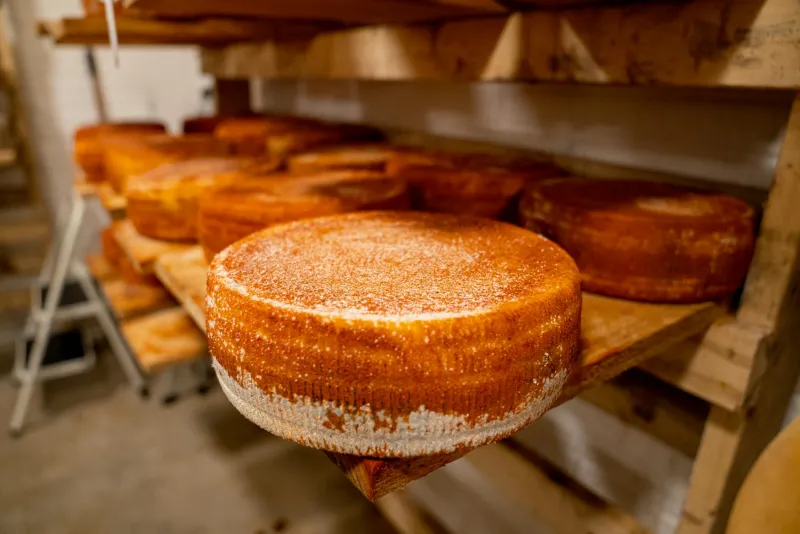
Other varieties leaned into spice. Pepper-studded wheels, cheeses rubbed with annatto for a deep orange rind, and soft fresh cheeses made weekly from whatever milk the farm produced that day were all part of the landscape. Regional variation was significant. Dairy culture in Pennsylvania Dutch country looked different from what was happening in coastal Massachusetts or the Hudson Valley, where Dutch settlers had carried their own cheesemaking traditions across the Atlantic.
None of this was celebrated. It was just food. Which is partly why it was so easy to forget.
What Industrialization Did to American Cheese
The shift happened fast. In 1851, the first cheese factory in the United States opened in Oneida County, New York — and within a few decades, factory production had fundamentally changed what Americans expected cheese to be. Consistency replaced character. A wheel of factory cheddar looked and tasted the same whether it came from New York or Ohio, which was exactly the point.
By the early 20th century, the economics were brutal for small farmstead producers. Factory cheese was cheaper, more shelf-stable, and easier to distribute. The regional herb cheeses, the spiced wheels, the soft fresh varieties that required weekly production — all of it required labor and knowledge that didn't scale. One by one, those traditions faded, often dying with the generation that practiced them.
Then, in 1916, James Kraft patented a process for making processed cheese, and the cultural narrative shifted further. American cheese became a punchline — bland, industrial, the thing Europeans quietly pitied us for. What that story erased was the fact that there had been something worth mourning long before the foil-wrapped slice arrived.
The People Quietly Digging It Back Up
Here's where it gets interesting. Over the last fifteen or so years, a small but determined group of American cheesemakers has started treating colonial-era recipes not as curiosities but as actual blueprints.
Some are working from digitized historical records — agricultural society reports, household management manuals, early American cookbooks that include detailed cheesemaking instructions. Others are collaborating with food historians to reconstruct varieties that haven't been commercially produced in over a century.
Sage Derby has seen a modest revival in this context. A handful of small-batch producers, particularly in New England and the mid-Atlantic, have started making versions that hew closer to the original farmhouse style — real sage worked into the paste, longer aging times, a texture that's firmer and more complex than the bright-green supermarket versions that occasionally appear around the holidays. The difference, people who've tasted both will tell you, is significant.
Beyond sage Derby, there's renewed interest in annatto-rubbed aged wheels, in spiced farmhouse rounds, and in soft fresh cheeses made from single-herd milk in the style that would have been familiar to a colonial-era dairy farmer. None of this is mainstream. You're mostly finding it at farmers markets, through small CSA-style cheese subscriptions, or at the handful of specialty shops that actively seek out heritage producers.
But it's happening.
Why This Matters Beyond Nostalgia
There's a practical reason to pay attention to this revival that goes beyond historical curiosity. The flavor profiles of these older varieties are genuinely different from what dominates the American cheese counter today — and in ways that pair well with the kind of cooking a lot of people are gravitating toward right now.
Sage Derby alongside a roasted root vegetable dish. A spiced, aged farmhouse wheel with cured meats and pickled vegetables. A soft fresh cheese made the way it would have been made in 1780, eaten the same day with good bread and whatever fruit is in season. These aren't precious or complicated combinations. They're actually quite simple — which is the point.
American cheese culture didn't start with Velveeta. It didn't start with the first factory in Oneida County either. It started with people making practical food from what they had, flavoring it with what grew nearby, and aging it according to knowledge passed down through families and communities.
That story got buried. It's worth knowing it existed — and worth seeking out the people who are telling it again.