Laugh All You Want at Deep-Fried Butter — State Fairs Have Been Predicting the Future of Food for a Century
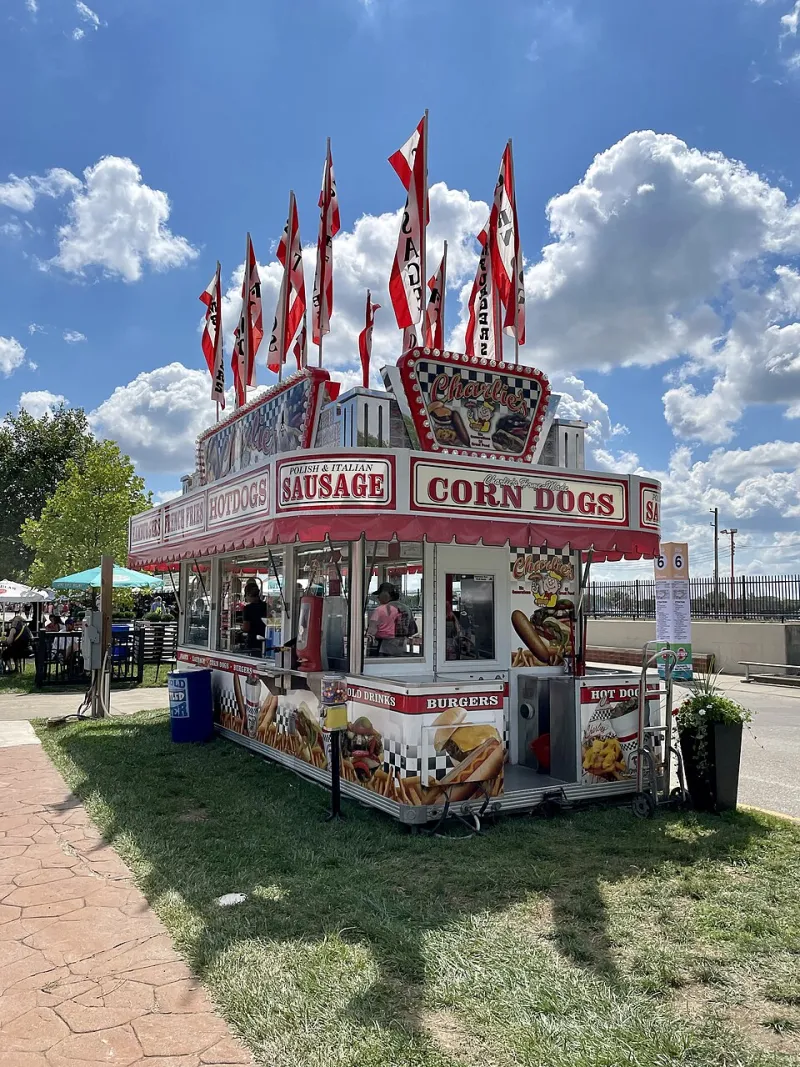
Photo: Dominic, CC0, via Wikimedia Commons
Every August and September, the same cycle plays out with clockwork reliability. Some vendor at the Texas State Fair — or the Iowa State Fair, or the Minnesota State Fair, it doesn't really matter — unveils a new creation. It is insane. It is deep-fried. It may involve a flavor combination that seems engineered to generate headlines rather than pleasure. The internet discovers it. Food writers produce essays about American decadence. Late-night hosts make jokes. And then, roughly five to seven years later, a version of that thing shows up on a gastropub menu in a major city, described with great seriousness as a bold exploration of contrast and texture.
 Photo: Iowa State Fair, via www.atkinsonblankets.co.uk
 Photo: Texas State Fair, via c8.alamy.com
This has happened enough times now that it can no longer be written off as coincidence.
State fair food isn't just spectacle. It's a surprisingly reliable early warning system for where American eating is actually headed — and has been for well over a hundred years.
The Fair as America's Real Test Kitchen
To understand why this works, you have to understand the specific conditions of the state fair food economy. Vendors at major state fairs are not casual hobbyists. They're entrepreneurs with a very specific, very high-stakes problem: they need to sell food to enormous crowds of people who are already overwhelmed with options, in a setting where novelty is essentially the entire marketing strategy.
This creates an innovation pressure that doesn't exist anywhere else in the food world. A vendor who debuts the same funnel cake they had last year doesn't generate foot traffic. A vendor who debuts something nobody has ever seen — or tasted — gets a line around the block and a spot on the local news. The incentive to experiment is total.
And because fair vendors are selling directly to real people — not food critics, not trend forecasters, not venture-backed restaurant groups — they get immediate, unfiltered feedback. Does it sell? Do people come back for seconds? Do they bring their friends over to try it? The fairground is a brutally honest market.
The Pipeline from Ridiculous to Respectable
Consider chocolate-covered bacon, which debuted at the Iowa State Fair in 2009 to the expected chorus of bewildered reactions. Salty and sweet? Meat and chocolate? Surely this was a sign of something going wrong with American culture.
Except the flavor logic was completely sound. Salt and fat amplify sweetness. Smoke and chocolate have deep chemical compatibility — they share aromatic compounds. Chocolatiers in Europe had known this for decades. The fair vendor just delivered the idea in the most direct, accessible, slightly absurd way possible. Within a few years, chocolate-covered bacon was appearing on artisan candy websites, in high-end gift boxes, and eventually in mainstream retail. The fair got there first.
Kool-Aid pickles — known in parts of the South as "Koolickles" — look, on the surface, like a prank. You soak dill pickles in a sweet Kool-Aid brine until they turn vivid red and take on a flavor that is simultaneously sour, salty, and intensely sweet. It sounds wrong. It has a loyal following in Mississippi Delta communities that predates any food trend coverage by decades. And the underlying principle — using aggressive sweetness to cut through brine, creating a layered pickle experience — is exactly what upscale pickle producers are now marketing to Brooklyn food shops at six dollars a jar.
Deep-fried Oreos debuted at the San Diego County Fair in 2002. They were everywhere by 2004. By 2010, the "deep-fried dessert" concept had migrated into serious pastry kitchens as tempura-style doughnuts and battered ice cream constructions. The fair version was crude. The technique was real.
 Photo: San Diego County Fair, via m.media-amazon.com
The Deep-Fried Butter Moment
And then there's deep-fried butter, which Abel Gonzales Jr. introduced at the Texas State Fair in 2009 and which remains the gold standard of fair food absurdity. He won the Big Tex Choice Award for it. He also, arguably, was doing something that French cuisine had understood for centuries: that butter, when heated rapidly in a sealed environment, becomes something transcendent — rich, nutty, almost caramelized. The batter was just delivery. The principle was classical.
Nobody was writing that in 2009. They were writing about heart attacks. But the logic was there.
Why the Fair Gets There First
The fair food pipeline works for a few specific reasons that are worth naming directly.
First, fair vendors have almost no barrier to experimentation. You're working a temporary stand with a deep fryer and a creative idea. You don't need a liquor license, a Michelin-star reputation, or a $3 million restaurant buildout. You need a concept and the nerve to execute it in front of strangers.
Second, fair crowds are genuinely adventurous in ways that restaurant diners aren't. There's a permission structure at a state fair that doesn't exist elsewhere. You're already in a place of spectacle and excess. You've already had a funnel cake and watched a goat competition. Trying something weird feels appropriate. That psychological looseness makes fair crowds willing to try combinations that would seem too risky in a conventional dining context.
Third — and this is the part food trend watchers consistently underestimate — fair vendors are often working from intuition rooted in real cultural knowledge. The Koolickle wasn't invented by a trend forecaster. It came out of a specific community food tradition. Deep-fried versions of regional specialties reflect genuine local flavor preferences. The fair is a place where vernacular food culture gets amplified, not invented from scratch.
What the Fair Is Telling Us Right Now
If the pipeline holds — and the evidence suggests it does — then whatever is currently generating the most eye-rolls at state fairs this season is worth paying attention to. Savory-sweet hybrids keep appearing. Fermented and brined elements keep showing up in unexpected contexts. And the obsession with extreme texture contrast — crunchy exteriors, molten interiors, chewiness against crispness — has been a fair constant for twenty years and shows no signs of fading from mainstream menus.
The county fairground has never been a sophisticated place. That's precisely why it keeps being right.