Before Pie Ruled the Table, Americans Were Eating Desserts You'd Have to Drink With a Spoon
Before Pie Ruled the Table, Americans Were Eating Desserts You'd Have to Drink With a Spoon
Pie is so embedded in American food identity that questioning its dominance feels almost unpatriotic. Apple pie. Cherry pie. The whole metaphor of it. But here's the thing — pie didn't start as America's dessert. It worked its way there. And for a long stretch of colonial and early American history, the sweet course at the end of a meal was something much stranger, much more interesting, and considerably harder to categorize.
It was closer to a drink than a slice. It lived in a glass as often as on a plate. And it required no oven whatsoever.
The Desserts That Time Forgot
Syllabub, flummery, and fruit fool. If those words mean anything to you at all, you probably encountered them in a historical novel or a colonial cooking exhibit. They sound fussy and archaic. But in the kitchens of 17th and 18th-century America — and in England before that — these were the desserts. Celebrated, requested, made for company, and considered markers of a skilled and well-provisioned household.
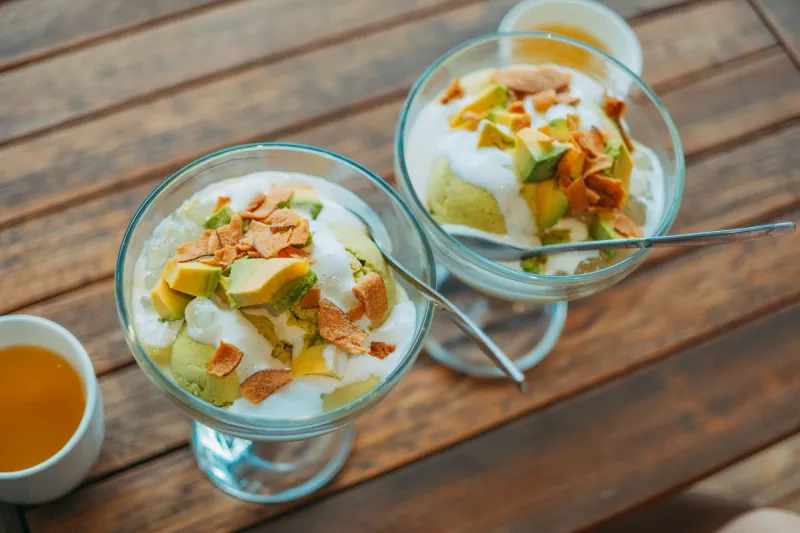
A syllabub, at its simplest, was sweetened cream whipped or frothed with wine or cider until it became thick and airy. Some versions were drinkable — a kind of early alcoholic milkshake. Others set up into something spoonable, almost like a loose whipped cream with boozy depth. You served it in glasses, topped with a froth that smelled faintly of sherry or Madeira, and you ate it with a long spoon.
Flummery was thickened — typically with oatmeal or later with starch — into a trembling, pale pudding that could be molded and unmolded and served with cream or fruit. It had a texture that modern eaters might describe as panna cotta-adjacent: delicate, cool, barely holding its shape. Fruit fools were perhaps the simplest: crushed or stewed fruit folded into whipped cream, served cold. Tart gooseberries were traditional in England; early American cooks adapted the concept to whatever was abundant — rhubarb, raspberries, quince.
Why No Oven? That Was the Point.
The no-bake nature of these desserts wasn't a limitation — it was a feature. Colonial kitchens were built around open hearths, and managing fire for baking was genuinely difficult and labor-intensive. Desserts that could be assembled without sustained heat were practical, elegant solutions for households that wanted something impressive without committing an entire afternoon to fire management.
This also meant that these sweets were, in a sense, ingredient-forward in ways that modern baking often isn't. You couldn't hide behind structure. There was no cake crumb to absorb a mediocre flavor, no pastry shell to give texture where there wasn't any. A syllabub was cream, wine, sugar, and lemon peel. If the cream wasn't good, the wine wasn't interesting, and the lemon wasn't fresh, you had nothing. The dish demanded quality ingredients and rewarded them honestly.
Food historian Sandra Sherman, who has written extensively about early modern English food culture, has pointed out that these desserts represented a sophisticated culinary tradition that got largely erased when industrial baking made ovens cheap and convenient. The skills required to make them well — knowing when cream was whipped to exactly the right consistency, understanding how wine acidity affected sweetness, judging the set of a flummery by eye — were real skills that simply stopped being transmitted when easier alternatives appeared.
 Photo: Sandra Sherman, via shop.guitarversum.com
The Industrial Kitchen's Great Standardization
The 19th century changed everything. Cast iron stoves became affordable for middle-class households. Baking powder simplified leavening. Flour mills made refined flour cheap and consistent. Suddenly, baking was accessible in a way it had never been before, and the American kitchen reorganized itself around the oven.
Pie was the great beneficiary of this shift. It was versatile, filling, suited to both sweet and savory preparations, and it traveled and stored in ways that syllabub absolutely did not. By the time American food culture was consolidating its identity in the late 19th century, pie had become the default comfort dessert and the older no-bake traditions had faded to the point of near-invisibility.
Cookbooks kept the recipes technically alive, but fewer and fewer home cooks were actually making them. By the mid-20th century, syllabub was a curiosity. Flummery was practically a joke word. Fruit fool survived in some British households but was barely known in America.
The Quiet Revival
Here's where it gets genuinely interesting for anyone who cooks today: a small but enthusiastic wave of food historians, historical cooking enthusiasts, and adventurous home cooks has been reviving these desserts — and discovering that they're not just historically curious but genuinely delicious and almost absurdly well-suited to modern cooking habits.
No oven. Minimal equipment. A handful of high-quality ingredients. Done in under 20 minutes. Served cold, which means you can make them hours ahead. For anyone who has ever stressed about timing a hot dessert around a dinner party, syllabub is a revelation.
Historical cooking channels on YouTube have introduced these recipes to audiences who had never heard of them and found themselves immediately charmed. Food writers covering the intersection of history and modern cooking have started including them in articles about forgotten techniques. A few ambitious restaurants with historically-minded menus have added fruit fools or syllabubs to dessert lists, usually described carefully enough that diners aren't confused but intrigued.
The fruit fool in particular has proven to have obvious modern appeal. Rhubarb fool. Strawberry fool. Blackberry fool. Swap in crème fraîche for some of the cream and the tartness gets interesting. Add a little vanilla or a scrape of citrus zest and suddenly you have something that feels both ancient and completely contemporary.
A Dessert Genuinely Ahead of Its Time
What's striking about these colonial sweets, looked at through a modern lens, is how well they align with things contemporary food culture actually values. Simple ingredients. No processed additions. Technique over equipment. Seasonal fruit. The kind of restraint that lets one good thing — a ripe peach, a glass of decent sherry, real cream — carry an entire dish.
They weren't eliminated because they were inferior. They were eliminated because the industrial food system didn't need them. Pie could be standardized, packaged, and sold. Syllabub couldn't.
But in a home kitchen, with good cream and something worth drinking and fruit that actually tastes like fruit? The old desserts make a surprisingly strong case for themselves. They just needed someone to finally order them off the forgotten menu.