The Fellowship Hall Archives: How Church Potlucks Became America's Most Unlikely Culinary Time Capsule
The Fellowship Hall Archives: How Church Potlucks Became America's Most Unlikely Culinary Time Capsule
Somewhere in a small town in eastern Tennessee, there's a recipe for a sweet potato casserole that doesn't exist anywhere on the internet. It was never published. Never photographed for a magazine spread. Never featured on a cooking show. It lives on a grease-spotted index card tucked inside a recipe box that belongs to a woman named Edna, who learned it from her mother, who learned it from hers. The only place you'll ever actually taste it is at the First Baptist Church fellowship supper — if you know someone who knows someone.
That's not unusual. That's basically how American food culture survived.
The Original Underground Food Network
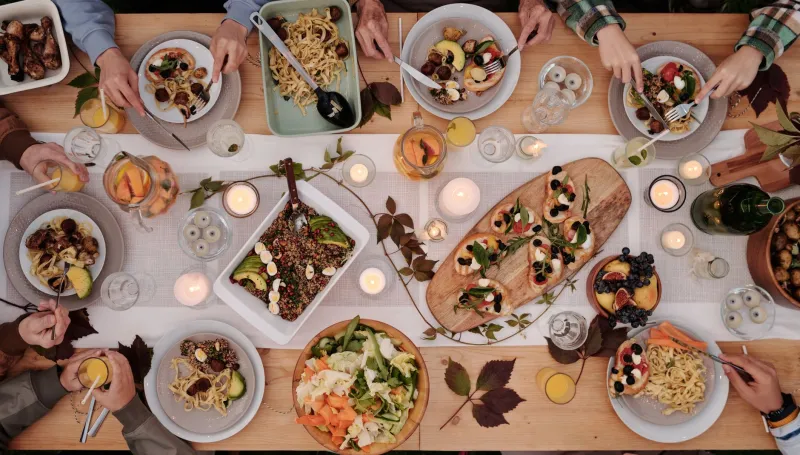
Before the Food Network existed, before Yelp reviews and Instagram reels, before food tourism became a legitimate hobby, there was the church potluck. And for generations of American communities — particularly in the rural South, the Midwest, Appalachia, and immigrant-heavy industrial towns — those weekly or monthly communal meals were doing something nobody fully appreciated at the time: preserving an entire layer of regional cuisine that commercial food culture couldn't touch.
Restaurants simplified. Cookbooks standardized. Grocery store brands homogenized. But the fellowship hall? Nobody was optimizing for scale in there. You brought what you made at home. You made what your family had always made. And if your grandmother came over from Slovakia in 1910 and her stuffed cabbage rolls were still the best thing anyone in the county had ever tasted, those cabbage rolls showed up on that table every single month until the recipe passed to someone else who kept making them.
That's not sentimentality. That's an actual preservation mechanism.
What Got Saved That Shouldn't Have Survived
Food historians who study regional American cooking keep running into the same surprise: dishes they assumed had vanished decades ago still exist — not in restaurants, not in academic archives, but in the recipe collections of church communities.
Congealed salads, for instance. Those jiggly Jell-O molds with vegetables or fruit suspended inside them look like a punchline now, but they were a legitimate culinary tradition with roots in 19th-century aspic-making. By all rights they should have disappeared entirely when food culture moved on. Instead, they hung around in church cookbooks across the South and Midwest, made by women who genuinely believed in them and had no interest in what food trends said.
Same with certain slow-cooked bean dishes, regional variations of corn pudding, Depression-era casseroles built from canned goods and ingenuity, and immigrant recipes that had quietly adapted to American pantries over two or three generations. These weren't museum pieces. They were living dishes, evolving slightly each time they were made, staying alive because someone kept making them for a crowd that kept eating them.
The Unsung Archivists
Here's the part that almost never gets acknowledged: the people doing this preservation work were overwhelmingly older women in small communities who received exactly zero recognition for it.
Food culture has always had a complicated relationship with home cooking. Professional chefs get celebrated. Cookbook authors get book deals. Food bloggers get brand partnerships. But the woman who has made the same green bean casserole for 40 years of church suppers, who has quietly passed that recipe to three younger women in the congregation, who has kept a culinary tradition alive through sheer consistency and generosity — she's invisible to the mainstream food conversation.
Which is a genuine loss, because what she knows is often irreplaceable. Not just the recipes, but the context. The why behind the dish. Why you use lard instead of butter. Why you soak the dried beans overnight in this particular way. Why the seasoning is heavier than you'd expect. That knowledge lives in the doing, and it travels person-to-person, not page-to-page.
The Church Cookbook Phenomenon
One artifact of this tradition did make it into the wider world: the church cookbook. Those spiral-bound, photocopied collections sold as fundraisers became one of the most underrated primary sources in American food history. They're messy and inconsistent — recipes often assume you already know things, measurements are approximate, instructions skip steps that every experienced cook would know to take. But that's exactly what makes them valuable.
They capture real home cooking. Not aspirational cooking. Not restaurant cooking. The actual food that actual people were making in actual American kitchens across the country, organized by community rather than by trend.
Food scholars have started treating them more seriously in recent years, mining them for regional patterns, immigrant influences, and techniques that don't appear in any other written record. A church cookbook from a Norwegian Lutheran congregation in Minnesota in 1962 is, in a very real sense, a document of how Norwegian food culture adapted to the American Midwest over two generations.
Why It Matters Right Now
Here's the uncomfortable truth: this preservation system is fragile. The older generations who carried these recipes are aging. Younger members of these communities often didn't grow up learning the dishes. Fellowship hall attendance has declined across many denominations. The informal transmission of culinary knowledge that happened naturally for generations — standing next to someone in a church kitchen, watching them work, asking questions — doesn't happen as automatically anymore.
Some communities have started doing the work deliberately. Recording recipes from older members. Digitizing church cookbooks. Organizing cooking sessions where knowledge gets passed on intentionally rather than accidentally. It's not the same as organic transmission, but it's better than losing the information entirely.
A few food historians and independent researchers have started visiting rural churches specifically to document what's still there — not as culinary tourists, but as archivists who understand that the fellowship hall might be the last place certain recipes exist anywhere on earth.
The Dish Nobody Ordered
American food culture spends a lot of energy celebrating chefs, restaurants, and the next big ingredient. That's fine. But the most honest record of what Americans actually ate — the full, complicated, regionally specific, immigrant-inflected, economically shaped reality of American food — lives in church basements, on index cards, in spiral-bound cookbooks that cost three dollars at a rummage sale.
Edna's sweet potato casserole isn't going to get a James Beard nomination. But it has outlasted every food trend of the last half century. And if you're lucky enough to eat it someday, you'll understand immediately why someone kept making it.