Your Grandmother Never Measured Anything — And Her Food Was Better For It
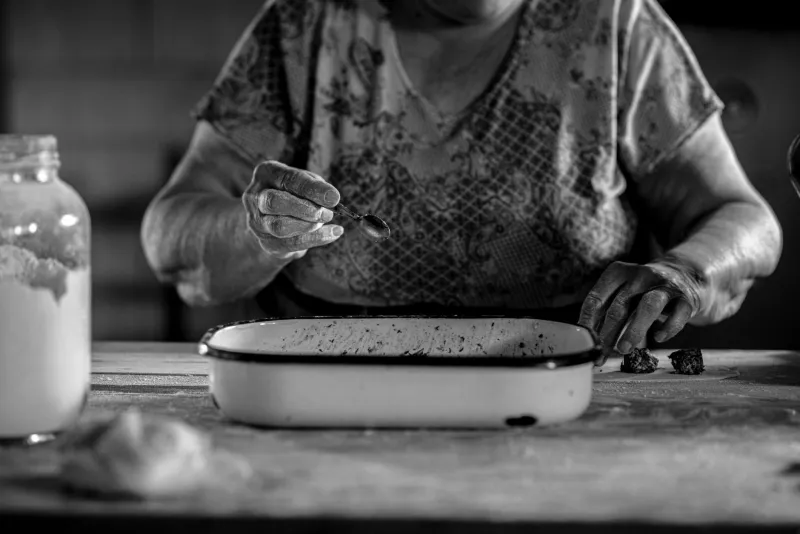
Somewhere in a kitchen drawer, tucked behind expired coupons and a rubber band ball nobody remembers making, there's probably a handwritten recipe card. If you're lucky enough to have one from a grandparent or great-aunt, you already know the problem: the instructions don't make sense. "A handful of flour." "Cook until it smells right." "Season to taste" — as if that explains anything at all.
Here's the thing, though. Those cooks weren't being careless. They were operating on a completely different system — one that worked beautifully for generations before anyone thought to standardize it.
The Kitchen Before the Measuring Cup
Fannie Farmer is usually credited with popularizing standardized measurements in American cooking. Her 1896 Boston Cooking-School Cook Book pushed for level measurements and consistent quantities at a time when "a piece of butter the size of a walnut" was still a perfectly acceptable instruction in print. The goal was noble: make cooking teachable, repeatable, and accessible to anyone — not just people who'd spent years watching someone else do it.
But what that shift slowly erased was a whole tradition of ratio-based, sensory-driven cooking that had sustained American families for centuries before that.
Pre-standardized home cooks weren't guessing. They were working from internalized ratios — the rough proportions between fat, flour, and liquid that produce a biscuit, or the balance of acid and sweet that makes a good pan sauce. These weren't written down because they didn't need to be. They lived in the hands and noses of the people who cooked every single day.
What "Pinch and Taste" Actually Means
The phrase sounds vague, maybe even a little romantic. But "pinch and taste" cooking is genuinely technical — it's just that the technology is the cook's body rather than a set of tools.
Experienced cooks who learned this way could feel when a dough had enough flour by the way it pulled away from the bowl. They knew when a stew needed more salt by the flatness on the back of the tongue. They could judge oven temperature by holding a hand near the door, a method that sounds imprecise until you realize it worked reliably enough to feed families through every decade of American history up to and including World War II.
What's interesting is that the ratios themselves were often more flexible than modern recipes allow. A good biscuit, for example, operates on a fat-to-flour ratio that can tolerate quite a bit of variation — something a recipe card with precise quarter-teaspoon measurements actively hides from you. When everything is spelled out, you stop learning how the dish actually works.
Why Modern Cooks Struggle to Recreate These Dishes
Anyone who's tried to reverse-engineer a grandmother's recipe knows the particular frustration of it. You follow the card exactly — or try to, decoding the "some" and "enough" as best you can — and the result is close but not quite right. Slightly flatter. A little less fragrant. Missing something you can't name.
Part of that is ingredient drift. Flour protein content has changed. Butter fat percentages vary by brand. Regional differences in water hardness affect bread doughs in ways that no printed recipe accounts for. A cook working by feel would have adjusted instinctively for all of these variables. A cook following a fixed recipe has no idea the adjustment is even necessary.
But the bigger issue is that intuitive cooking is a skill that atrophies without practice. When every recipe tells you exactly what to do, you never develop the muscle memory — or the sensory vocabulary — to know what a dish needs in the moment. You become dependent on the recipe rather than on your own judgment.
The Quiet Return to Feeling It Out
Something interesting is happening in American home kitchens right now. Cooking forums and food communities are filling up with people who are deliberately stepping away from measured recipes, not out of laziness but out of a genuine desire to cook the way their grandparents did. They're learning ratios — the 3-2-1 pie crust, the 1:1:1 mirepoix, the basic vinaigrette proportions — and using those as jumping-off points rather than fixed destinations.
Cooks like Samin Nosrat, whose book Salt, Fat, Acid, Heat is essentially a manual for intuitive cooking, have helped reframe what it means to understand a dish rather than just follow it. The goal isn't to abandon recipes entirely — they're genuinely useful, especially for baking chemistry that doesn't forgive improvisation — but to understand the principles underneath them well enough to adapt.
That's exactly what those grandmothers were doing. They weren't winging it. They were cooking from deep knowledge, expressed through touch and taste rather than tablespoons.
What We Actually Lost
The standardization of American cooking gave us accessibility and consistency. It made cooking teachable in classrooms and scalable for cookbooks. Those are real benefits. But it also quietly trained several generations of home cooks to distrust their own senses — to reach for a measuring spoon rather than taste the pot, to follow a timer rather than smell the oven.
What we lost wasn't just a collection of recipes. It was a whole way of knowing food — an embodied literacy that used to pass naturally from one generation to the next, hand over hand, at the stove.
The good news is that it's recoverable. It just takes some practice, a willingness to make mistakes, and maybe a little less faith in the quarter-teaspoon.
Start with something forgiving. Make soup. Season it wrong on purpose, then fix it. Pay attention to what that takes. Do it again.
Your grandmother would recognize exactly what you're doing.